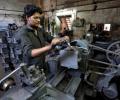
Industrial production grew 11.9 per cent in August mainly due to a low-base effect and good performance by manufacturing, mining and power sectors that surpassed the pre-COVID level. The manufacturing sector, which constitutes 77.63 per cent of the Index of Industrial Production (IIP), grew 9.7 per cent in August, according to the data released by the National Statistical Office (NSO) on Tuesday. The mining sector output rose 23.6 per cent in August, while power generation increased 16 per cent.

'The only violence I have had in any film of mine is a slap.' 'When Nikhil narrated the film to me, I was blown away.' 'I was literally screaming out of my chair.'
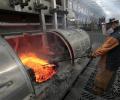
The Centre has conceded most of the demands of potential buyers of Neelachal Ispat Nigam Ltd (NINL). These include lowering the lock-in period for sale of assets to one year and allowing the new buyer to undertake the amalgamation of a special purpose vehicle (SPV) into NINL. An inter-ministerial group led by Department of Investment and Public Asset Management (Dipam) secretary Tuhin Kanta Pandey and the core group of secretaries on divestment (CGD) headed by Cabinet secretary Rajiv Gauba have decided that the lock-in period can be reduced to one year from the date of completion of sale, from the earlier three years proposed by Dipam, an official in the know said.

India's industrial production rose 3.1 per cent in September, according to official data released on Friday. As per the Index of Industrial Production (IIP) data by the National Statistical Office (NSO), the manufacturing sector's output surged 2.7 per cent in September 2021.

The government has held back the release of complete data of the Index of Industrial Production (IIP) for April, as was done for the same month last year due to the COVID-19 lockdown. Last year in June, the National Statistical Office (NSO) had held back the release of complete IIP data due to the effect of the nationwide lockdown on factory output. This year too industrial production was hit due to lockdown restrictions imposed by states to curb the second wave of the pandemic.

The headline for corporate profit growth has been very encouraging in the July-September quarter (Q2) of 2023-24 (FY24), with the combined net profit of listed companies up by 38 per cent year-on-year. However, the earnings distribution has been very lopsided, with most of the growth coming from public-sector oil-marketing companies (OMCs), banks, non-bank lenders, automobile (auto) companies, and cement producers. By comparison, companies from information technology services, fast-moving consumer goods (FMCG), retail, and consumer durables were disappointed, experiencing a sharp slowdown in net sales growth and a relatively muted increase in reported net profit.

India's industrial production growth remained subdued for the second straight month and expanded by 3.2 per cent in October, mainly due to the waning low base effect while mining, power and manufacturing sectors performed well. The manufacturing sector, which constitutes 77.63 per cent of the Index of Industrial Production (IIP), grew two per cent in October, according to data released by the National Statistical Office (NSO) on Friday. The mining sector output rose 11.4 per cent in October, while power generation increased 3.1 per cent.
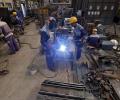
Industrial production growth entered positive territory after a gap of two months with a record 22.4 per cent rise in March this year, mainly due to the low-base effect and good show by manufacturing, mining and power sectors. The manufacturing sector -- which constitutes 77.63 per cent of the index of industrial production (IIP) -- grew by 25.8 per cent in March 2021, as per the data released by the National Statistical Office (NSO) on Wednesday. The mining sector output too grew 6.1 per cent in March, while power generation increased by 22.5 per cent.

Manufacturing sector production registered a decline of 17.1 per cent, while the output of mining and power fell 19.8 per cent and 10 per cent, respectively.

Industrial production contracted by 1.9 per cent in November, entering the negative territory after a two-month gap, mainly due to poor showing by manufacturing and mining sectors, official data showed on Tuesday. The manufacturing sector -- which constitutes 77.63 per cent of the index of industrial production (IIP) -- recorded a contraction of 1.7 per cent in November 2020, as per data released by the National Statistical Office (NSO). Mining sector output too witnessed a decline, shrinking 7.3 per cent.

India's economy grew by 13.5 per cent in the first quarter of the current fiscal, mainly due to the base effect, official data showed on Wednesday. The gross domestic product (GDP) had expanded by 20.1 per cent in the corresponding April-June period of 2021-22, according to data released by the National Statistical Office (NSO). Many analysts had projected the Indian economy will expand at a double-digit growth rate due to the base effect.

'Yet the market didn't do all that badly because it was cushioned by domestic inflows.'

'...they were shocked to learn that just 352 Indian soldiers had made 3 brigadiers, 2 colonels, 170 officers, 290 JCOs and 8,000 troops surrender to the Indian Army.'

The finance ministry on Wednesday reimposed expenditure curbs on ministries and government departments for July-September quarter. There will be no spending restrictions on the ministries of health, rural development, agriculture, MSME (micro, small and medium enterprises) and railways as part of a two-pronged strategy. "The existing guidelines for expenditure control have been reviewed. "Keeping in view the evolving situation arising out of Covid-19 and anticipated cash position of the government, it is felt essential to regulate Quarterly Expenditure Plan (QEP)/Monthly Expenditure Plan (MEP) of specific ministries/departments for July-September, 2021," the Department of Economic Affairs in the finance ministry said in a notification.

'We are lucky to have found each other and to have grown and been together for so many years.'

Amid protests by Opposition members seeking a debate on price rise, the Lok Sabha on Friday passed the Indian Antarctic Bill, 2022, which seeks to extend the application of domestic laws to research stations set up by India in the Antarctic region.
The Indian economy remains on track to regain its position as the world's fastest-growing major economy after official estimates on Friday put the expansion at a tempered 9.2 per cent this fiscal amid concerns over the impact of a resurgent virus on the fragile recovery. The growth in the gross domestic product (GDP) of 9.2 per cent in April 2021 to March 2022 fiscal (FY 2021-22) given by the National Statistical Office (NSO) in its first advance estimate compares with 9.5 per cent expansion forecast by the Reserve Bank of India (RBI) last month. The economy had contracted by 7.3 per cent in the previous financial year.
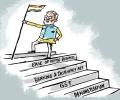
India's GDP expanded 13.5 per cent in the April-June quarter, the quickest pace in a year, to retain the world's fastest growing economy tag but rising interest costs and the looming threat of a recession in major world economies could slow the momentum in the coming quarters.

The growth in the contact-intensive portion of the economy trailed our expectation, highlighting how imperative it is for confidence to improve, either through accelerated vaccinations or otherwise, to drive a sustainable recovery in these sectors, asserts Aditi Nayar.

India's economic growth surged to 20.1 per cent in the April-June quarter of this fiscal, helped by a low base of the year-ago period, despite a devastating second wave of COVID-19. The gross domestic product (GDP) had contracted by 24.4 per cent in the corresponding April-June quarter of 2020-21, according to data released by the National Statistical Office (NSO) on Tuesday. The government had imposed a nationwide lockdown at the onset of the COVID-19 pandemic last year.
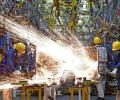
Industrial production declined by 10.4 per cent in July, mainly due to lower output of manufacturing, mining and power generation, as per the government data released on Friday.

Avoid clicking on any unknown links from strangers. Use a different, secure password for each social media account you have.

'We are planning load shedding in such a way that the entire state will not suffer.'

The World Bank has retained India's economic growth forecast for the current fiscal at 8.3 per cent as the recovery is yet to become broad-based. As per the first advanced estimates of the national income released by the National Statistical Office (NSO) last week, the economy is projected to grow at 9.2 per cent in 2021-22, surpassing pre-COVID level in actual terms, mainly on account of improved performance, especially in farm, mining and manufacturing sectors. "India's economy is expected to expand by 8.3 per cent in fiscal year 2021/22 (ending March 2022), unchanged from last June's forecast as the recovery is yet to become broad-based.
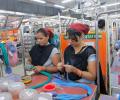
The growth is particularly remarkable because it comes at levels higher than during the pre-Covid times, notes Mahesh Vyas.

India's industrial production growth slowed down for a fourth straight month in December to 0.4 per cent mainly due to a poor performance by the manufacturing sector. The manufacturing sector, which constitutes 77.63 per cent of the Index of Industrial Production (IIP), contracted by 0.1 per cent in December, according to the data released by the National Statistical Office (NSO) on Friday. In December 2021, the mining output rose by 2.6 per cent, and power generation increased by 2.8 per cent.

A delegation of Congress leaders, including Lok Sabha MP Gaurav Gogoi and All India Congress Committee general secretaries Jitendra Singh and Ajoy Kumar were stopped at Jorhat airport by the district administration on Wednesday when they were on way to Nagaland, where the Army gunned down 13 civilians in a botched anti-surgency operation.

Ten central trade unions except Bharatiya Mazdoor Sangh are observing one-day general strike on Thursday to protest against various government policies.

India's economic growth slowed to 8.4 per cent in the second quarter of 2021-22, mainly due to waning low base effect, official data showed on Tuesday. The GDP growth in April-June quarter this fiscal stood at 20.1 per cent. The Indian economy had contracted by 24.4 per cent in April-June last year.

The second wave of the pandemic in the country has derailed the recovery momentum of the domestic auto industry, which was poised for a comeback in the current fiscal after witnessing the two consecutive challenging years, ratings agency ICRA said on Thursday. Unlike the first wave where infections were largely localised to urban clusters, the second wave has seen deeper and wider penetration, including into rural hinterlands. Accordingly, outlook for various segments has been revised downwards, it said.

'My experience in Bollywood has been an interesting one.' 'It has shaped me as a person.'

Describing China as its 'most important partner', the Afghan Taliban has said it looks to Beijing to rebuild Afghanistan and exploit its rich copper deposits as the war-ravaged country faces widespread hunger and fears of an economic collapse.

'There is no such thing as ultimate survivability.'
'It's all comparative -- who outperforms, who uses tactics, who optimises technology to the best is what makes the difference.'

All but two women and four men among the Games' 128 archers agreed to participate, with data retained only in the form of archived TV footage.

'Goa is a tiny state, but in terms of its Business of Politics, several powerful lobbies of India are involved in it, be it the mining lobby, hoteliers' lobby, casino lobby, hawala lobby, drugs lobby etc.'

Delhi Capitals head coach Ricky Ponting is aware that it might be possible to retain only three to four players before IPL's mega auction but given a chance he would love to enter the next season with almost the same team he has now.

Billionaires are not only eyeing a profit as they push mankind out into the stars.
It appears India will be among those nations consigned to being among the watchers and not participants of this crucial phase, observes Aakar Patel.
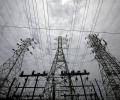
Growth in power demand remains in negative though it is picking up as coronavirus-related restrictions are eased.

The guidelines listed several services including government and private offices that will be out of bounds during the period, while exempting establishments such as hospitals, ration shops, dairies, banks, insurance offices, and print and electronic media. Delivery of all essential goods including food, pharmaceuticals, medical equipment through e-commerce has also been exempted from the purview of the lockdown.

Royal Challengers Bangalore captain Virat Kohli described team-mate AB de Villiers's unbeaten 33-ball 73, which set up a comprehensive victory over Kolkata Knight Riders in the Indian Premier League on Monday, as "superhuman" effort.
